The social stigma faced by unmarried mothers and mistresses
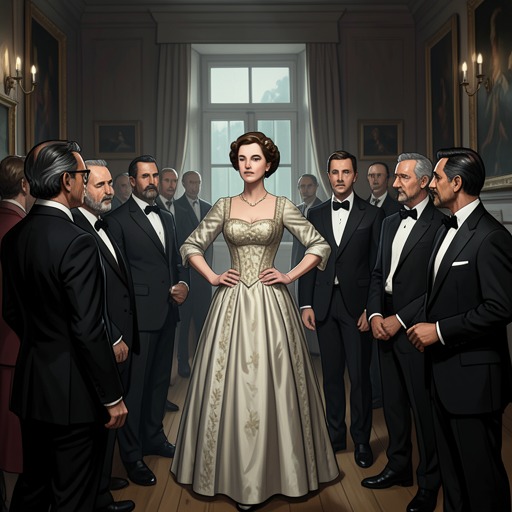
The Florios of SicilyThe social stigma faced by unmarried mothers and mistresses is a force that turns Giulia Portalupi’s love for Vincenzo Florio into public disgrace and private isolation. It is enforced not only by contemptuous outsiders but also by her family’s attempts to hide her pregnancy, her lover’s refusal to marry or acknowledge their daughters, and the furtive rituals surrounding the children. Giulia’s eventual insistence that Vincenzo recognize the family marks a change in her standing, but the years of shame and exclusion remain part of what that recognition costs.
Respectability and social exclusion
Giulia begins as a respected young woman whose life has been organized around serving her mother and family. After becoming Vincenzo’s mistress, she enters a position the narrative sharply distinguishes from the socially tolerated arrangement of a nobleman keeping a lover: Vincenzo is a wealthy trader, not a nobleman. In the eyes of many, Giulia is little more than a courtesan and he is merely a nouveau riche. His money can make people fear him, but it cannot shield either of them from their contempt. Her changed status is therefore not simply private disgrace; it exposes the class boundaries that decide whose sexual arrangements society will excuse.
Vincenzo’s promise of protection does not amount to marriage or equal standing. When Giulia’s father asks whether he will take care of her, Vincenzo says he will, while making no offer to marry her. Seven days later Giulia enters his apartment as its mistress, accompanied by a maid he has placed at her disposal. She is at once painfully happy and guilty: love has changed her from someone to conceal into a daughter her family is ashamed of, yet she understands that her new household cannot confer respectability. The material provision of an apartment and servant coexists with a social identity defined by dependence and contempt.
Pregnancy, family pressure, and constrained choices
When Giulia becomes pregnant, she turns to her mother hoping for comfort, but Antonia responds with anger and fear, asking what they will do about the expected child and the shame. Ill and coughing, Antonia is herself too frail and absorbed in her condition to give the protection Giulia seeks. The family’s concern soon takes the form of a proposed erasure: Antonia suggests paying a discreet midwife to end the pregnancy and remove every trace of the disgrace. Giulia refuses, firmly and with her eyes lowered.
Antonia then orders her daughter to leave Palermo for Milan, where she can stay with Aunt Lorena, give birth away from home, and let the family decide what happens afterward. Giulia refuses to go. She knows that people may insult her and call her a whore, but she would rather remain near Vincenzo than surrender the little he is willing to give her. Her choice is not freedom from stigma; it is a decision about which constrained life she will endure. The family offers concealment and distance as remedies for dishonor, while Giulia accepts the exposure because separation from Vincenzo would cost her the relationship she has chosen to keep.
Children kept outside recognition
The stigma continues after the births. At the baptism of Giulia’s second daughter, the priest comes to the house in haste, with no altar servant; the ceremony is clandestine, like one for an illegitimate child. Neither of Giulia’s parents attends. Her elder daughter calls for her mother while Giovanni distracts the child with the news that her grandmother has made sweets. Ordinary family tenderness sits beside a rite conducted in secrecy: the children are present within the household, but their status keeps them outside its public acknowledgment.
Giulia describes the pattern as repeating the experience of Angelina: the daughters are hers, and no one else’s, because Vincenzo will not acknowledge them. The solitude and growing contempt become burdens she can no longer tolerate. She tells Vincenzo she could bear gossip and scorn for the sake of his love, but that they now have two daughters who need a father. She asks him to stop pursuing dreams of glory long enough to accept responsibility for them. Vincenzo answers that advantage can make people overlook almost anything, but says his mother will never permit the marriage and that, under the law as he understands it, he cannot marry without her consent. Giulia counters that because he is over thirty, the law requires him to give his mother notice of his intent. She asks him at least to acknowledge the girls and give them the possibility of a legitimate father. The argument reveals how family authority and legal status reinforce the stigma: affection and private support cannot by themselves give the children the recognized place Giulia seeks.
Recognition and the limits of repair
After Giulia gives birth to a son, she sees Vincenzo hold the baby and call him his blood, his darling, and the light of his life. She uses that moment to make her demand explicit: having given him a son, she wants her honor restored, and he must acknowledge not only the boy but the daughters as well. When Vincenzo promises that the children will bear his name and that Giulia will bear it too, her tears express relief and liberation. His words mean that her life will no longer remain concealed and marked by shame.
The promise arrives only after four years of loneliness, contempt, and reproach from Giulia’s family. She recalls arguments, separations and reconciliations, Giuseppina’s insults, and Antonia’s hostile silences. Recognition changes the family’s public position, but it does not make the preceding years disappear or turn the earlier secrecy into acceptance freely given. The stigma has operated through repeated refusals, absent relatives, hidden ceremonies, and the pressure to erase or send away the pregnant woman; its partial reversal requires Giulia to claim honor directly and make the children’s place an explicit obligation.
Coercion and the unequal terms of intimacy
The wider pattern of the novel complicates any simple account of these relationships as freely chosen romance. Earlier, Paolo Florio insists that Giuseppina must move with him to Palermo because he is her husband, declaring that she will go even if he has to drag her by the hair. Later, when she refuses sex, he squeezes her against the stove, lifts her skirt, and leads her by the wrist to the bedroom, where he undresses her while she keeps her eyes shut. In another scene, Ignazio Florio holds her tightly as her nightdress opens. These episodes place women’s bodily vulnerability and constrained choices alongside the social judgment imposed on women who become mistresses or unmarried mothers.
Vincenzo’s encounters with Giulia are also depicted through force as well as desire. When she tries to leave, he stops her with his rough hands on her bare shoulders and drags her into the dark. Later, after saying their relationship must end, he takes off her hat and kisses her despite her attempt to push him away; he subsequently seizes her wrist and tears the lace of her dress. The narration also presents Giulia’s desire and her ambivalence, but those responses do not erase the actions that constrain her. Her later status as his mistress, and the children’s lack of acknowledgment, emerge within a relationship where emotional attachment and unequal power coexist. That tension makes the social stigma more than a label attached to an unconventional household: it is part of a system in which the woman bears public shame while the wealthy man retains greater control over recognition, security, and the terms of their shared life.